


Jon Ivan Gill, of Gustavus Adolphus College, delivered the Powell Lecture in Religious Studies, exploring hip-hop's influence and intersections with philosophy, religion and social justice.
In the Powell Lecture in Religious Studies, Jon Ivan Gill described hip-hop as more than a musical genre, it’s 鈥渁 way of life and culture that manifests in all elements.
Gill 鈥� visiting assistant professor of philosophy at Gustavus Adolphus College and cross-community coordinator at the Center for Process Studies 鈥斅燿elivered the lecture in McBride Gathering Space on Monday, Oct. 28. The lecture is hosted by the Department of Religious Studies.
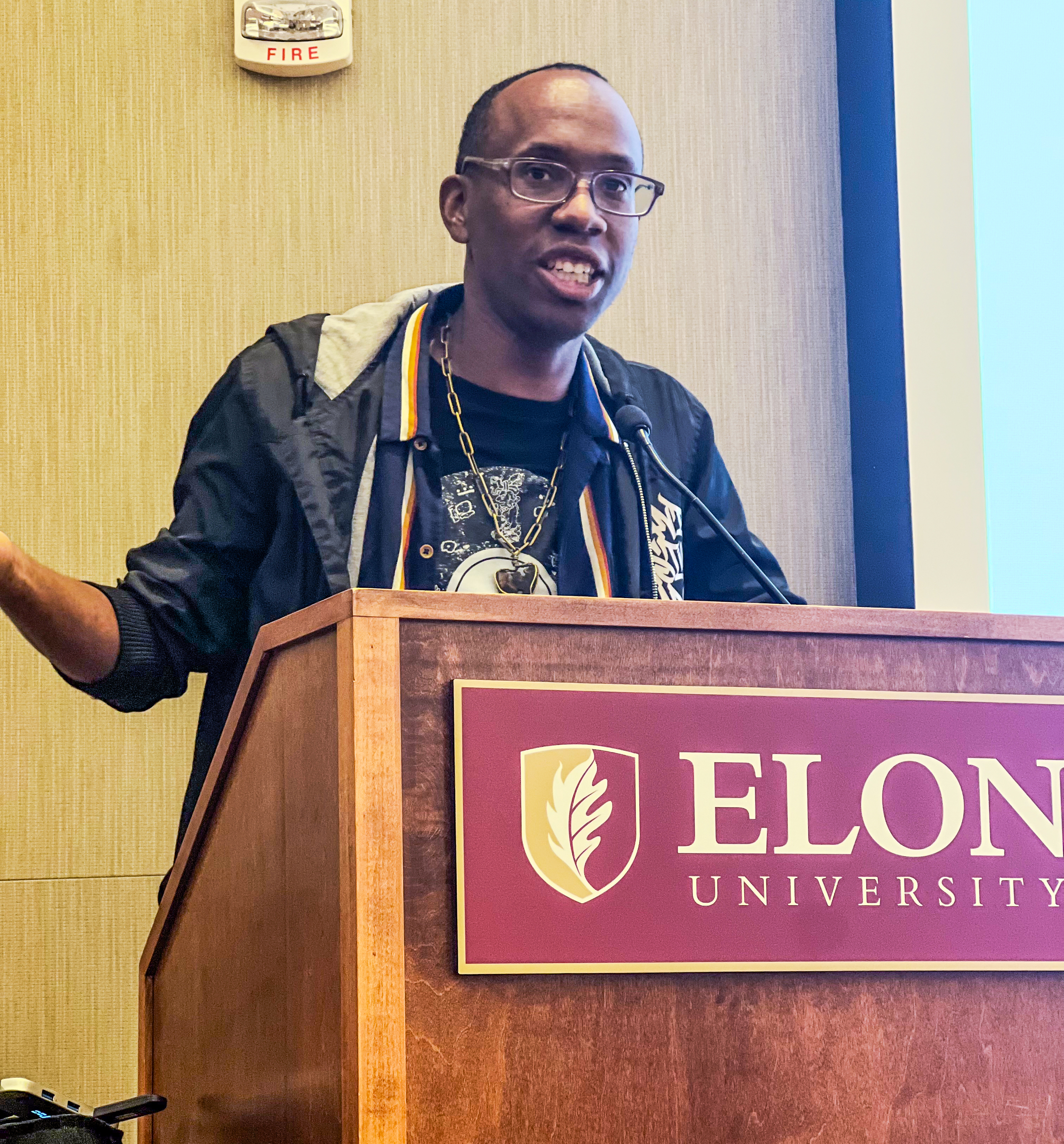
He has written extensively on philosophy, religion and race, and is an active figure in the hip-hop world. He co-owns Serious Cartoons Records and Tapes in San Bernardino, California, with Michael Adame and participates in rap collectives such as Tomorrow Kings, Echoes of Oratory Musik and Crystal Radio.
Gill explored the concept of underground hip-hop, which operates as a space where core values like authenticity and self-determination thrive, separate from the racialized narratives often found in mainstream media.
鈥淭here is a social critique that thrives in the realm of the underground,鈥� Gill said, emphasizing how this sector of hip-hop champions justice and community.
During his lecture, Gill also introduced the 鈥淭emple of Hip-Hop鈥� as a framework for understanding the genre鈥檚 ritualistic and spiritual dimensions. He described underground hip-hop as a 鈥渞eligious shrine organism,鈥� where artists pay homage to the genre鈥檚 pioneers, or 鈥渆lders of the culture,鈥� in ways that resemble sacred traditions.
鈥淏y religion, we mean the existential and metaphysical arrangements of human experience,鈥� he said, noting that hip-hop enables people to see the world through a transformative lens, combining expression with social meaning.
Gill also spoke about the philosophical and communal aspects of hip-hop, illustrating the genre鈥檚 power to offer guidance and unity through creative expression.
鈥淚f hip-hop didn鈥檛 do anything else, it rescued the children of a scattered and impoverished people from a certain death,鈥� he said.
Hip-hop serves as a 鈥渕ulti-post-racial utopia,鈥� he said, helping people find deeper meaning and value in the world. Through these perspectives, Gill encouraged attendees to view hip-hop not merely as music but as a force that 鈥渆stablishes meaning鈥� in a world in need of connection and purpose.