


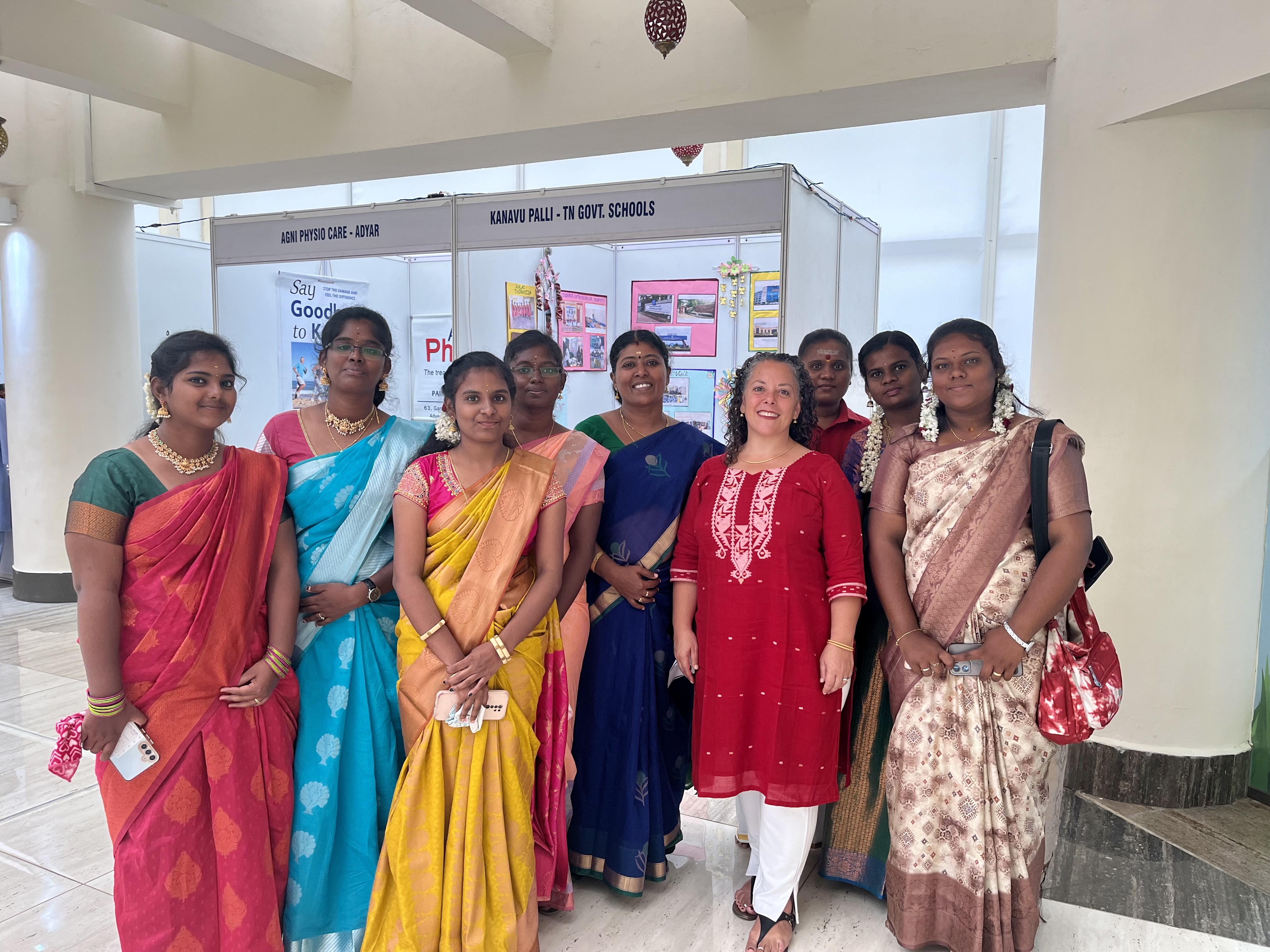
Professor of Religious Studies Amy Allocco delivered seven invited lectures and conference presentations in five countries and offered six workshops during her full-year sabbatical
Professor of Religious Studies Amy Allocco spent the 2023-24 academic year in South India on a Fulbright-Nehru Academic and Professional Excellence Fellowship engaged in research for a project titled 鈥淭he Drummer-Priests of South India: Intergenerational Learning in a Tamil Performance Tradition.鈥�
Allocco鈥檚 nine-month ethnographic study focused on one hereditary family of Tamil Hindu ritual drummers called pampaikk膩rar. Allocco accompanied the ritual drummers to dozens of engagements 鈥� from temple festivals to government-sponsored heritage events to domestic family rituals to post-death story recitations 鈥� to document their song story, and ritual repertoires.
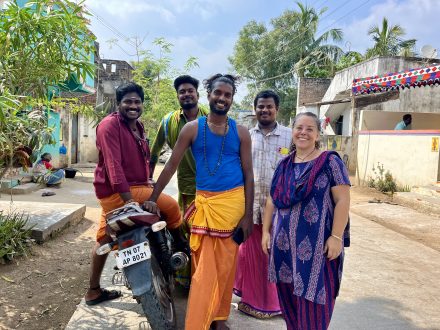
During her sabbatical, Allocco also presented her research at two invited lectures in India and at four international conferences. At the Indian Institute of Technology-Madras in Chennai, the capital city of Tamil Nadu, whose Department of Humanities and Social Sciences offered Allocco an affiliation during her Fulbright, she presented, 鈥淩itual Arts, Access, and Aesthetics: Sensory Dimensions of Tamil Hinduism.鈥� Her talk adopted approaches from disability studies to consider the varied modes of engagement with the divine available in Hindu ritual contexts.
At Sri Sivasubramaniya Nadar (SSN)聽College in Chennai, she presented, 鈥淒rumming, Decoration, Divination, and Dialogue: Vernacular Tamil Hindu Modalities.鈥� In this talk, she proposed that the musician-priests鈥� performances prompt us to consider the fundamental roles of decoration, flame, water and dialogue in Hindu ritual contexts in contrast to scholarly models that have long privileged sight (darshan).
Two of the four conference papers that Allocco delivered in connection with her current research project were delivered in person, while two were presented online at hybrid conferences. Her in-person presentations were 鈥淭echnologies of Insistence and Resistance in Rituals to Call the Dead in Hindu South India鈥� at the European Association for the Study of Religions/International Association for the History of Religions in Vilnius, Lithuania and 鈥淭races of the Deified Dead in Hindu South India鈥� at the International Society for Academic Research on Shamanism (ISARS) at Sapienza University of Rome, Italy.
Allocco presented 鈥淩itual Relationships with the Dead in Hindu South India鈥� virtually at The First International Conference on Critical South Asian Death Studies at the University of M眉nster and 鈥淜inship, Gender, Power, and Place in Tamil Rituals to Domesticate the Dead鈥� online as part of a full-day symposium dedicated to Tamil religion at The Annual Conference on South Asia at the University of Wisconsin at Madison.
In addition to these four presentations on her scholarship, Allocco was an invited speaker in a plenary session at the International Association for the History of Religions (IAHR) Special Conference hosted by the University of Tokyo in Japan. Her paper, 鈥溾�楨ngaged,鈥� 鈥楶olitical,鈥� and 鈥楽cientific鈥� Study of Religion: Perspectives from the American Academy,鈥� situated how the study of religion is framed in the United States vis-脿-vis the ways it is approached in global contexts. It will be published in the peer-reviewed journal, Religious Studies in Japan.
During her fellowship research in India, Allocco applied for and was awarded a Fulbright Scholar South and Central Asia Regional Travel Grant to present workshops in Sri Lanka. Over the course of eight days, Allocco shared her expertise with various organizations serving war-affected and marginalized populations in the Tamil-speaking north and east regions of Sri Lanka. She employed the UNESCO Story Circle methodology to facilitate interreligious understanding and interethnic engagement with the 35 women participants from the Mahasakthy Women鈥檚 Federation who participated in her full-day 鈥淪torytelling for Personal Healing and Intercultural Learning鈥� workshop.
In addition to offering a half-day workshop titled 鈥淓ngagement Across Difference with UNESCO Story Circles鈥� for students at St. John鈥檚 Vocational Training Centre in Batticaloa, she presented a session focused on research and writing skills with the same NGO. Allocco also led a mentoring session with graduate students affiliated with the University of Jaffna, conducted field visits with a women鈥檚 development officer and consulted with the leadership team of a grassroots feminist organization.
Allocco was pleased to be able to serve the US India Education Foundation (USIEF), which administers the Fulbright program in India, by sharing her expertise in three interactive sessions. She presented a workshop called 鈥淲riting an Effective Research Proposal鈥� during International Education Week as part of a program for Ph.D. students and early career faculty at the United States consulate in Chennai. Her second and third presentations, 鈥淐onducting Research in India鈥� and 鈥淟iving in India,鈥� were offered at the Fulbright Student Researchers鈥� Orientation in New Delhi and the Fulbright English Teaching Assistants Orientation in Chennai.
Finally, Allocco made substantial progress on her scholarship while conducting fieldwork in India during her sabbatical. She wrote and submitted one journal article, one book chapter and a co-edited volume, each of which are now under review. Allocco also wrapped up her work during a final grant meeting with Xenia Zeiler, professor of South Asian studies at the University of Helsinki, related to their joint project, 鈥淪weetening and Intensification: Currents Shaping Hindu Practices.鈥� Their collaboration is funded by a Collaborative International Research Grant awarded by the American Academy of Religion (AAR) and will culminate in the publication of a co-edited volume (under contract with State University of New York Press) with the same name. The volume includes Zeiler and Allocco鈥檚 co-written critical introduction, a chapter authored by Allocco, and 12 other chapters contributed by a diverse cohort of international scholars.