


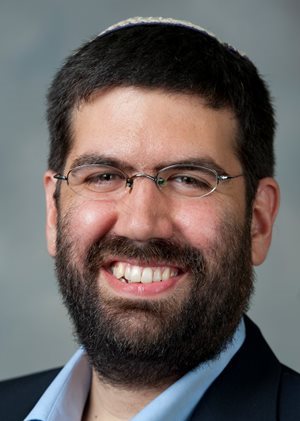
This column by Geoffrey Claussen, professor of religious studies, the Lori and Eric Sklut Professor in Jewish Studies, and the chair of the Department of Religious Studies, was published by the Charlotte Observer, the Raleigh News & Observer and the Durham Herald-Sun.
By Geoffrey Claussen
Antisemitism is widely understood as a form of racism, a product of sweeping negative generalizations about Jews.
The defines it as 鈥渄iscrimination, prejudice, hostility or violence against Jews as Jews (or Jewish institutions as Jewish).鈥� That definition is recommended by hundreds of Holocaust Studies, Jewish Studies and Middle East Studies professors throughout the world, including North Carolina scholars like me.
For fervent defenders of the State of Israel such a definition is not good enough. They鈥檝e found their preferred framework in the International Holocaust Remembrance Alliance鈥檚 , which encourages labeling strong critiques of Israel as antisemitic.
North Carolina鈥檚 SHALOM ACT 鈥� this week and sent to Gov. Roy Cooper for his signature 鈥� adopts the IHRA framework. Cooper must veto this bill.
The enshrines a controversial definition of antisemitism into state law.
The IHRA framework is an effective tool for stifling criticism of Israel because its list of examples of antisemitism includes items such as 鈥渄enying the Jewish people their right to self-determination, e.g., by claiming that the existence of a State of Israel is a racist endeavor鈥� and 鈥渄rawing comparisons of contemporary Israeli policy to that of the Nazis.鈥� These examples are routinely used to label those who accuse Israel of apartheid or genocide as antisemitic 鈥� and silence them.
Those supporting this bill claim they are supporting Jews in North Carolina. But Jews in North Carolina, like Jews elsewhere in the country, are sharply divided over how to define antisemitism. While Israel-focused groups affiliated with the Jewish Federations of North America have backed the SHALOM Act, more liberal Jewish organizations such as Carolina Jews for Justice have strongly opposed it.
The bill is grounded in a misguided generalization about Jews, assuming that support for Israel is inherent to being Jewish. But harsh criticism of Israel is widespread among Jews.
A found that a quarter of American Jews believe that 鈥淚srael is an apartheid state,鈥� while only 31% of Jews believe such a claim to be antisemitic. The SHALOM Act would have the perverse effect of encouraging state officials to label significant portions of our Jewish community as antisemitic, and such labeling will have limited support from our community.
The primary sponsor of the SHALOM Act, House Speaker Tim Moore, has claimed that he is seeking to protect Jewish college students. But as should be clear to anyone who has observed college campuses this year, many Jewish students are harsh critics of Israel. The 2021 survey found that 38% of Jews under 40 view Israel as an apartheid state, and such views appear even more common among today鈥檚 students.
Under Moore鈥檚 legislation, many of my Jewish students would readily be labeled antisemitic by the state of North Carolina. They typically see their critiques of Israel as expressions of their Jewish identities. It is unacceptable for the state of North Carolina to decide their expressions of Jewishness are out of bounds.
Strikingly, many advocates of the Shalom Act oppose applying these same sorts of standards to the protection of other ethnic groups. Many of them oppose Palestinian self-determination but do not believe that they are therefore guilty of anti-Palestinian racism, nor do they think it is a sign of bigotry to deny self-determination to thousands of other groups that do not have states of their own.
Why embrace a different standard when defining antisemitism? Better public policy would use the same sorts of standards to define racism and prejudice against Jews that are used to define racism and prejudice against other groups.
Those of us who teach about these issues on college campuses are dedicated to supporting all students, including our Jewish, Muslim, Israeli and Palestinian students, by confronting those who show racism and prejudice towards them. We鈥檙e also dedicated to defending them when they are accused of antisemitism merely because of their political views.
If Cooper wishes to support our diverse students, and the diversity of Jews in North Carolina, he must veto this bill.
—
Views expressed in this column are the author鈥檚 own and not necessarily those of 黑料不打烊.