


Charity Blackwell delivers a keynote address focusing on understanding one鈥檚 identity to aid in DEI advocacy during the Intersect 2022 Conference on Nov. 12.
鈥淚 write because it鈥檚 therapy. My pen is always there for me. I fight because my team is strong. They helped me move my weight along,鈥� Charity Blackwell quoted during her poem 鈥淧oetry and Soccer鈥� at the keynote address of the Intersect Diversity and Leadership conference held Nov. 11-12.
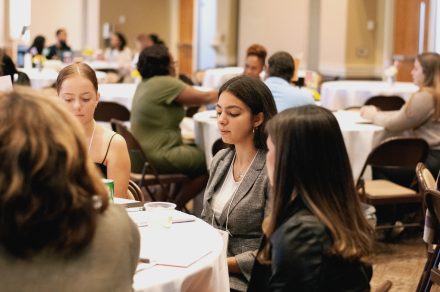
Intersect is an annual two-day conference hosted by the Center for Leadership and the Center for Race, Ethnicity and Diversity Education (CREDE) that examines diversity, leadership and the cross-sections between the disciplines. This year鈥檚 theme, 鈥淧eriod. End of sentence. Rewriting the Narrative.鈥� focused on reclaiming narrative against stories and stereotypes that are often told about us but are not our own.聽
Nadine Jose 鈥�23, student director for education for the Intersect 2022 Conference, shared that the conference committee felt Blackwell was an obvious choice as a keynote speaker due to how she has taken ownership of her own story and experience. “We thought she was just a perfect fit to go our theme,” Jose said.
Blackwell is a spoken word artist, host, emcee and poetry specialist. She received her bachelor’s and master’s degrees in communications from Trinity University. Currently, she is the director of creative arts and the Director of Poetry Events (D.O.P.E.) at Busboys and Poets.
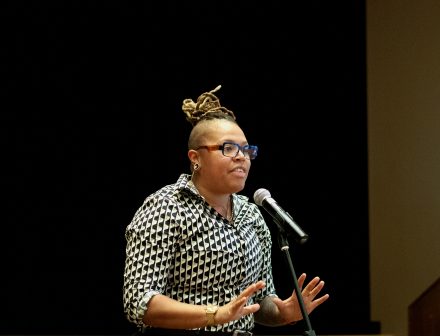
Blackwell鈥檚 address focused on the journey of how understanding your own identity can help provide the most effective impact in the work of diversity, equity and inclusion (DEI). Blackwell provided a different style of keynote delivery by encouraging audience engagement and integrating poetry throughout her address.
She introduced herself by sharing the many aspects that are a part of her identity. Two vital pieces are poetry and soccer. Her first poem during the address was appropriately named 鈥淧oetry and Soccer.鈥� As she ended the poem, she stated that one鈥檚 passions are part of their identity. She then revealed that grief was one of her identities since the loss of her parents, stating that grief never leaves.
鈥淪ometimes it鈥檚 over here a little bit, but it comes back. And it鈥檒l go over here a little bit and then it comes back to a point where I had to finally one day acknowledge that is a part of me. This is something that I鈥檓 going to live with the rest of my life,鈥� Blackwell said.
However, she expressed that all her identities, including grief, have shaped who she is today. She stated that she uses poetry as her outlet to bring the many aspects of her identity together.
Transitioning, Blackwell stated she believed that many conversations regarding diversity, equity and inclusion (DEI) were occurring but were missing something. She told the audience that as leaders, they must have the ability to create a middle ground to ensure diversity and equity. However, despite her educational background, she learned that DEI work only matters if one first works on themselves internally. Introducing the term “use of self,” she explained that an individual鈥檚 lived experiences are how they approach DEI work.
鈥淲hen it comes to DEI, you are the most powerful tool. No one has walked in your shoes. No one has experienced what you have from your perspective. Your personal lived experiences are what shape you and determine how you will approach the work, how you will show up in these spaces,鈥� Blackwell said.
鈥淲hen it comes to DEI, you are the most powerful tool. No one has walked in your shoes. No one has experienced what you have from your perspective.
She also emphasized that one must be as centered as possible to use their self as a tool by using their lived experiences to be impactful, ultimately teaching others and creating a space to learn. Therefore, understanding yourself and looking within is the journey鈥檚 first step.
鈥淵ou have to be able to understand who you are first, all the different parts of your identity, and come to terms with that and be okay with that so that when you show up in spaces, you can check yourself at the door to have the most impactful change possible,鈥� Blackwell said.
She then provided the second step of the journey, which is understanding not only your marginalized identities but your privileges too. She shared how at times, her oppressed identities overshadow her privileges.
鈥淚 forgot I still have a lot of privileges that I had to consider. And because I鈥檓 so into my own oppressions [and] identities, I鈥檓 leaving out folks that are also in this battle with us. At this intersection, when we are talking about intersectionality, I have to come to terms with and understand how I鈥檓 showing up into spaces,鈥� Blackwell said.
She continued expressing that one must also understand their privileges when showing up for others.
鈥淪ometimes understanding not just your marginalized part of who you are but also your privileges. I preach that to white folks, but even for us as Black folks that we have to understand all of our privileges when we are showing up for other people because our stories are not modeling,鈥� Blackwell said. 鈥淚 think we鈥檙e seeing that a lot that people want to box Black people into one group, with one way of thinking, and there鈥檚 so many different thoughts out there,鈥� Blackwell said.
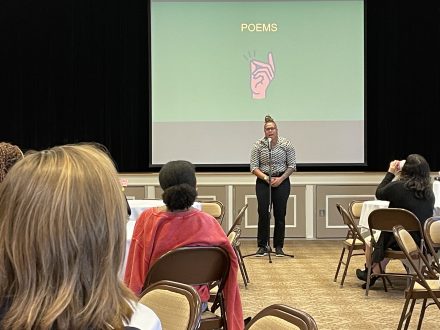
Ending the address, she recited several poems centered around aspects of her identity. The first poem was titled 鈥淪wiss African American.鈥� She told a story about a trip to Switzerland with one of the children from her organization. They were selected to be in a film along with other children from other countries. She also shared that this was during the period of the Trayvon Martin trial. During the poem, she shares parts of her conversations with other Black chaperones from different parts of the world. She stated she learned 鈥渉ow American and Black American she was.鈥�
She continued with a poem centered around her history and experiences as a Black woman. Dedicated to her late mother, she named the poem 鈥淭he Gift of Giving,鈥� stating, 鈥淪he said that giving is something that cannot be measured. In fact, it is a treasure. Something like a gift because the gift of giving is an ancient tradition as an extension of our ancestors.鈥�
The following poem was titled 鈥淐ookie,鈥� relating to her childhood as a Girl Scout and tapping into her grief. She stated that it took her a long time to create an ending, but she finally understood that the poem wasn鈥檛 supposed to have an end. 鈥淭his is a poem about grief. I could never figure out this ending. And I was like because it鈥檚 not supposed to have a happy ending,鈥� Blackwell said.
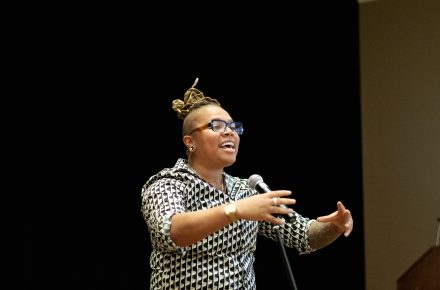
The last poem, titled 鈥淪haq,鈥� was dedicated to her later father. She explained that she and her father connected and communicated through sports. The poem tells a story of her remembering, during a basketball game, the free-throw shot technique her father taught her. Her father was supportive no matter the game鈥檚 outcome. She also established a correlation between life and free throws stating, 鈥淚 now realize that I had and will continue to shoot free throws my entire life. This world is nothing but the basketball court, and most of the time, our biggest enemy is ourselves,鈥� Blackwell said.
Blackwell closed the address, encouraging the audience to continue unpacking their identities and to check themselves at the door when showing up to spaces. Blackwell鈥檚 dynamic address had a powerful impact on the audience, allowing them to have an eye-opening experience that prompted self-reflection and discovery.
鈥淚 think it鈥檚 very impactful in the sense that it kind of makes you examine yourself in ways that you wouldn鈥檛 normally, said Connor Vaughn 鈥�26. 鈥� We tend to focus outwardly, and don鈥檛 necessarily take the time to focus on who you are, your identify, and what has impacted you,鈥� Vaughn said.
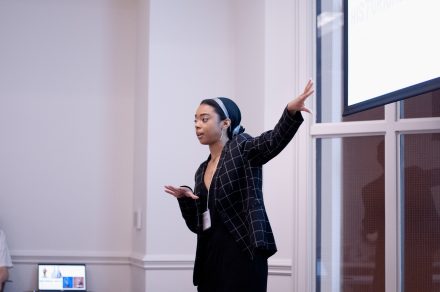
Madison Williams 鈥�25 and Morgan Williams 鈥�25 felt a similar impact. 鈥淭he keynote speaker really made me think about how my identities are expressed and how I show up with them in the world because it is something that I鈥檝e not often thought about,鈥� Madison said.
Morgan said her biggest takeaway was 鈥渏ust knowing that my own positionality, as I鈥檝e learned, impacts how I interact with other people.鈥�
Contia鈥� Prince 鈥�18 G’19, UNC-Chapel Hill doctoral student and conference presenter, shared that she was impacted by Blackwell discussing how she navigated through grief while engaging in self-reflection and self-reflexivity.
鈥淟istening to her acknowledge that there are different parts of your identity and not all of them are pleasant, but you still have to bring even the unpleasant parts of you when you come to work to recognize how that impacts the way you should up in a different space,鈥� Prince said.
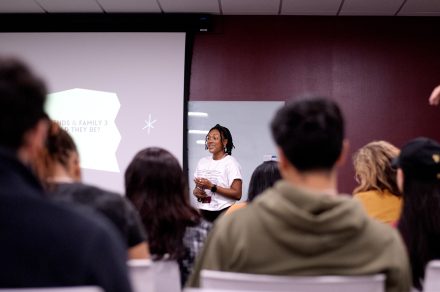
Other highlights of the Intersect conference included educational and roundtable sessions such as, 鈥淩ace. Religion. and the Ownership of Education,鈥� 鈥淚nclusive (student) Leadership,鈥� 鈥淟eading with Authenticity and Curiosity,鈥� and 鈥淏uilding Equitable Communities through Service.鈥�