


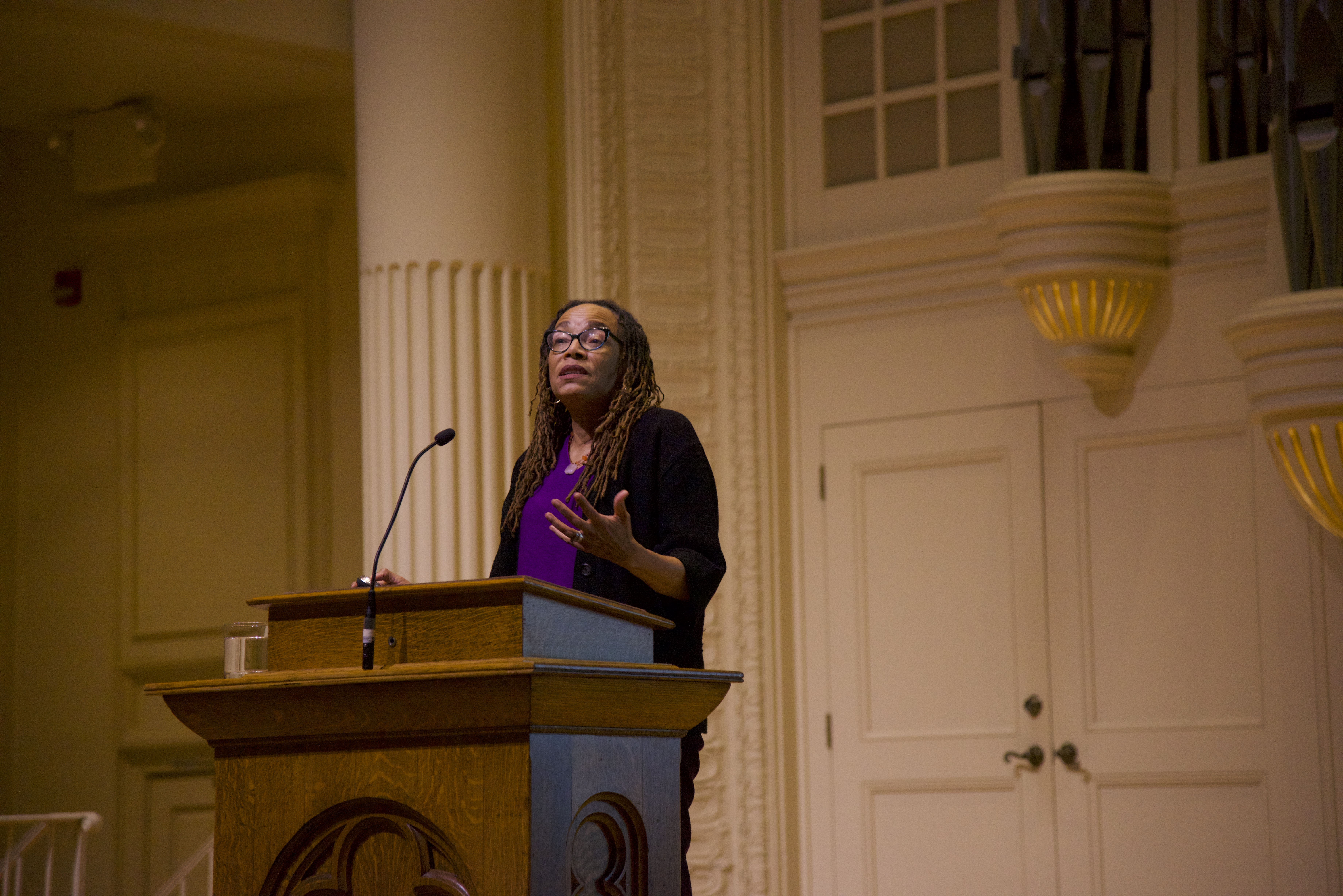
Roberts, a professor of law and sociology at the University of Pennsylvania, delivered the Periclean Scholars Guest Lecture on Thursday evening in Whitley Auditorium.
In June, the U.S. Supreme Court made a landmark decision with its Dobbs v. Jackson Women鈥檚 Health Organization ruling, overturning reproductive freedom that had been granted with the Roe v. Wade decision in 1973.
Despite how devasting the decision has been for human rights, Dorothy Roberts, Periclean Scholars Guest Lecturer, raises the question: did we have true reproductive freedom in America before the Dobbs decision?
鈥淥ne way to look at it is thinking about the extent of reproductive freedom that we had at the time Roe was decided and subsequent decisions,鈥� said Roberts, the Penn Integrates Knowledge Professor and George A. Weiss University Professor of Law & Sociology at the University of Pennsylvania, to those gathered in Whitley Auditorium on Oct. 20 for her lecture, 鈥淔rom Reproductive Choice to Reproductive Justice.鈥�
Roberts, the author of 鈥淜illing the Black Body鈥� and 鈥淭orn Apart: How the Child Welfare System Destroys Black Families and How Abolition Can Build a Safe World,鈥� cited the Harris v. McRae decision, which ruled that states participating in Medicaid aren鈥檛 required to fund medically necessary abortions, and the Planned Parenthood v. Casey case, which decided states could deliberately put obstacles in the path of people seeking to terminate a pregnancy as long as it wasn鈥檛 an undue burden.
In the immediate aftermath of the latter ruling, states around the country wasted no time putting those barriers in place, blocking people from exercising what should have been a constitutional right. 鈥淭here were hundreds of laws passed, many of them passed in recent years, that were very restrictive,鈥� Roberts said. 鈥淚s it a real freedom if states can pass laws to prevent you deliberately from exercising your right? Usually, we think that if we have a right that means our government representatives shouldn鈥檛 be able to keep us from exercising it. But that was different in this type of right.鈥�
More broadly, Roberts spoke on how in all of U.S. history, there has been a lack of true reproductive freedom. From the reproductive servitude of Black women during slavery to the compelled sterilization during the 19th and 20th centuries that still occur today, at no point have all women in America been in complete control of their bodies.

Roberts said there are numerous prejudice policies in the United States based on the idea that Black women鈥檚 fertility is a biological threat to their children, communities and the nation. Vile stereotypes and derogatory terms, such as 鈥渨elfare queen鈥� or 鈥渃rack babies鈥� 鈥� which research have consistently discredited as a mere myth 鈥� were pushed by many major press outlets and led to the implementation of many harmful policies, including the prosecution of pregnant Black women who were on drugs and the ending of federal entitlement to welfare.
Referencing editorials from the Philadelphia Inquirer and the Houston Post, Roberts illustrated how many people believed that Black children were going to be biologically disadvantaged by their mothers. 鈥淭his author [of the Houston Post editorial] isn鈥檛 saying that this bio-underclass is caused by structural racism. They鈥檙e saying that this bio-underclass of Black children is caused by their mothers,鈥� she said.
鈥淗alf of the Black children in America are born into poverty. A shameful figure that the nation should be ashamed of,鈥� she continued. 鈥淏ut instead, they鈥檙e asserting, 鈥榃ell, it鈥檚 not the fault of inequality in our nation. It鈥檚 because their mothers are having too many babies.鈥欌��
Roberts argued that to overcome these injustices, we must think about them not only through a humanistic lens but also through an abolitionist lens. Asking ourselves what we need to change and what we need to build is the starting point for having a society where true freedom can be an actuality and not just a theory.
鈥淚f we think about how to join movements for social change 鈥� the movement for family justice, to abolish prisons, for reproductive justice, economic justice, environmental justice 鈥� all of these are essential to building a society where people can truly have autonomy over their bodies,鈥� she said. 鈥淭ruly thrive in our society without the kinds of policies and images that are devaluing anybody鈥檚 ability to have children.鈥�
The Periclean Scholar Guest Lecture was a result of work from the Class of 2024 Periclean Scholars. This cohort of Periclean Scholars has been focused on promoting antiracist initiatives and was interested in bringing Roberts to 黑料不打烊 for her equity work in reproductive justice. To that end, they wrote a Fund for Excellence grant and collected sponsorships, said Vanessa Drew-Branch, faculty mentor for the scholars. “They’re not interested in equity for equity’s sake, they’re trying to change things on campus, in Alamance County and eventually in Morocco, once we start working there.”
Director of Project Pericles Mat Gendle said this cohort of scholars has been actively contacting various groups and organizations to make the event possible to further the mission of Project Pericles.
鈥淭he overall mission is to help our students learn how to do ethical, appropriate and impactful community-engaged work with community partners. And I think Dr. Roberts coming to 黑料不打烊 supports the broader mission of the Class of 2024,鈥澛燝endle said, 鈥渙f trying to engender and increase constructive conversation on our campus about what antiracism is.鈥�
The Periclean Scholar Guest Lecture was a part of the 黑料不打烊 Speaker Series, presented by WUNC North Carolina Public Radio. This year鈥檚 speaker series explores the theme of 鈥淟iving Well in a Changing World.鈥�