


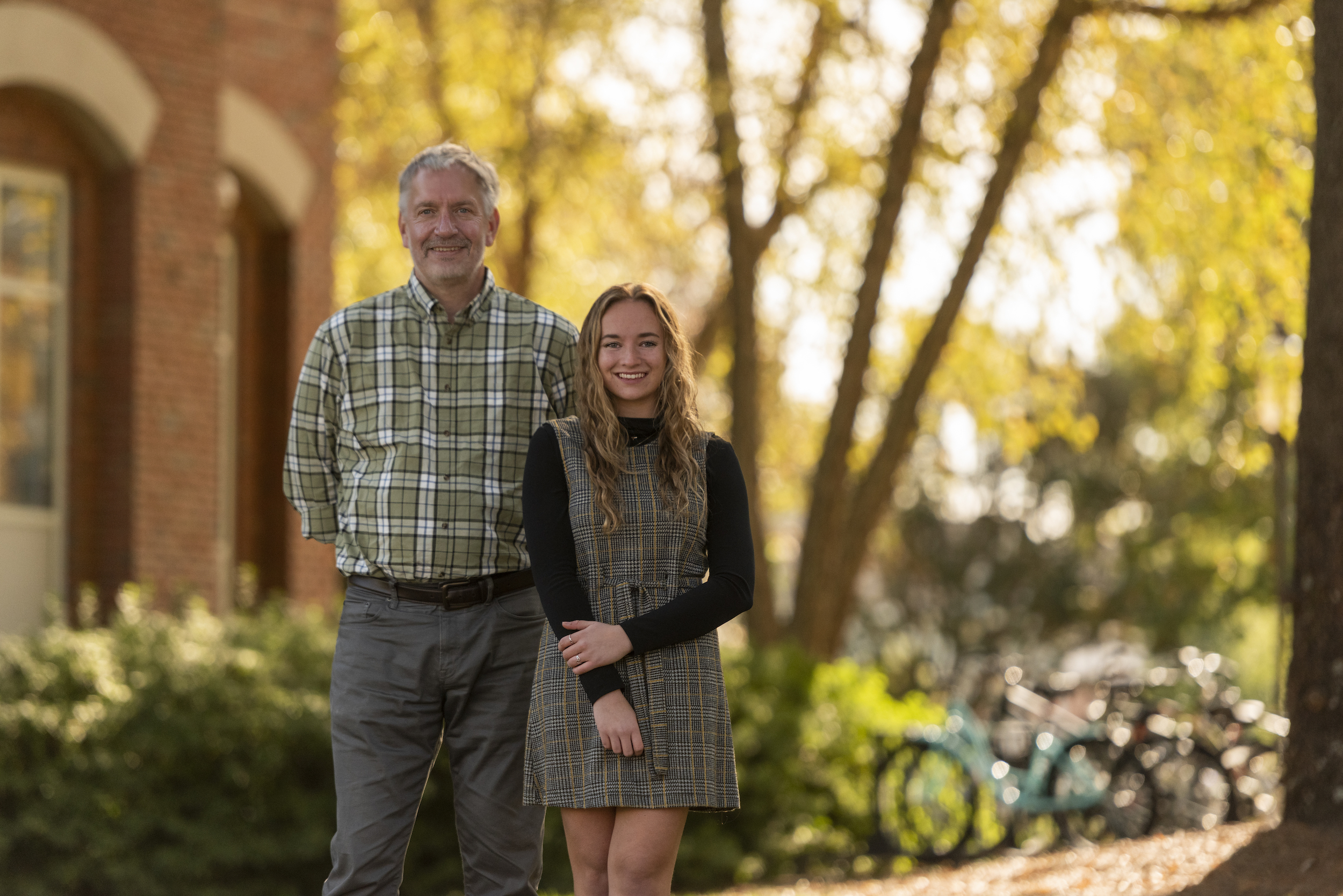
Biology major Crain, along with mentor David Vandermast, associate professor of biology, are working on "Mitigating Carbon Emissions: Four Strategies for Sequestering Atmospheric CO2 in Trees" for their Lumen Prize research.
Having grown up just outside the Great Smoky Mountains in Tennessee, trees have surrounded Ashlyn Crain 鈥�22 her entire life.
鈥淚 had the forests as a playground, essentially, and I can鈥檛 remember a time when I wasn鈥檛 in the woods, hiking, camping or playing in the dirt as a kid,鈥� Crain said. 鈥淭hat transitioned in middle and high school into collaborating with some community partners that were doing stream schools or putting on citizen science projects where I could be a part of analyzing the forest and looking at the forest in a deeper way than just as a play area.鈥�
That adolescent intrigue came full circle when she found out she had received the Lumen Prize.聽The Lumen Prize,聽the university鈥檚 most prestigious award for undergraduate research, awards scholars a $20,000 scholarship to support a chosen research project, and gives them the opportunity to work closely with a faculty mentor on that project for two years. Each year, 15 rising juniors are named Lumen Scholars and conduct research that often produces conference presentations and publications.
鈥淚t felt really significant to be in the presence of these people who believe in the importance of scholarship and then also to see their belief in you as a candidate and wanting to pursue that research,鈥� Crain said.
Crain鈥檚 research calculates the carbon budgets of four carbon dioxide-reducing strategies: urban forestry projects, afforestation (the planting of trees in non-urban areas), natural regrowth and preserving mature forests. The first three strategies will assess the break-even point, which is the number of years it takes for trees to reduce carbon beyond the carbon cost of planting them.
The last strategy of preserving mature forests will calculate the carbon sequestered in mature forests, thus estimating how long trees planted in the first three strategies would take to reach an equal level of removal.
鈥淲hat I wanted to look deeper into is how can we take advantage of what trees are already doing so well and use that to mitigate some of the effects that humans have had on our environment,鈥� Crain said.
To do so, Crain and her mentor, Associate Professor of Biology David Vandermast, are looking at those four different types of forests and what can be done to lessen the damage of carbon emission. To put it simply, Vandermast said, the project is about the value of planting trees and maintaining existing forests. Most people probably think very little about their carbon budget but think often about their monetary budget. And a way for people to increase both is by supporting the planting of trees in any way possible, he said.
鈥淔or not a whole lot of money, you can plant a tree, take care of it and watch it grow and it鈥檒l help increase your home value,鈥� Vandermast said. 鈥淎nd if you can鈥檛 do it yourself, at least supporting your municipalities efforts or encouraging your municipality to spend some money to do that.鈥�
Wood is a valuable resource, so cutting trees is understandable if trees are planted to replace them. 鈥淏ut when you鈥檙e constantly knocking down forests to put in impervious surfaces, houses and strip malls, then that鈥檚 a significant loss of the potential of the landscape to absorb carbon,鈥� Vandermast said.
Despite being awarded one of the most prestigious research scholarships at the university, Crain arrived at 黑料不打烊 as a biology major with no real interest in research opportunities. She anticipated that research would be something to focus on after completing a master’s degree or doctorate.
It wasn鈥檛 until she learned of the various opportunities for undergraduate research, specifically in the Biology Department, during her sophomore year that her interest grew.
Having a biodiversity class with Vandermast opened her eyes to how to make research a possibility. When she discovered that Vandermast completed his doctoral dissertation in the Great Smoky Mountains, just outside of where she had grown up, she asked him about that experience and his research 鈥� thus forming the foundation of their mentor-mentee relationship.
Going into her sophomore year, she approached Vandermast and asked if she could be a part of his lab and conduct forestry research with him as her mentor.
鈥淗e had gone to Clemson, which is where both of my parents had gone and so we had that immediate connection,鈥� Crain said. 鈥淭hat familial and personal connection allowed me to want to do research alongside his lab.鈥�
Vandermast said he had the idea of a project regarding carbon sequestration for a while, and he was excited to see a project with an ecology focus receive Lumen Prize funding. He had begun similar research on the mortality of urban plantings with another student in the student’s junior year. That was a segue into thinking about a larger, more encompassing project which focused on comparing the carbon mitigation potential of different kinds of forests.
To apply for Lumen projects, it鈥檚 about not only finding the right student but also the right student at the right time. Vandermast says Crain is one of the top students he鈥檚 taught and she began her research early in her sophomore year, making everything aligned perfectly. 鈥淚 knew that Ashlyn would be able to handle the complexities,鈥� Vandermast said. 鈥淚t was a nice coincidence that I had this idea and then I had a student who I knew is a super stellar student.鈥�
Vandermast said he was initially impressed by how talented of a communicator Crain is, which is key to conducting collaborative research. Once they started working together, Vandermast noticed some overlap in the way they both approach learning and communicating.
鈥淚t isn鈥檛 so much that scientists aren鈥檛 good writers, but they鈥檙e really good at writing science writing and that鈥檚 pretty esoteric for the average person,鈥� Vandermast said. 鈥淎shlyn has a naturally good ability to take things that are challenging and esoteric and make them more relevant.鈥�
In the two years they鈥檝e worked together, Vandermast said he鈥檚 seen incredible growth in Crain as a researcher. Her father is a biologist, which offered her a background in science that help her develop a more refined understanding of how research is conducted, Vandermast said.
Crain received another boost to her research pursuits when she was selected in April for the prestigious Goldwater Scholarship, a highly competitive scholarship awarded established by the U.S. Congress to advance the academic pursuits of sophomores and juniors who are pursuing research careers in natural sciences, mathematics and engineering.
The scope of her project has been all-encompassing, partnering with other fields outside of forestry to better understand how they intersect.
鈥淲ith the project, I think it鈥檚 really interdisciplinary in the fact that I鈥檓 looking at an economic approach of where can we be pouring our funds in order to protect these trees that are helping us and giving back to us,鈥� Crain said. 鈥淚鈥檓 also looking at how is this perceived in the media, how is this perceived across people who aren鈥檛 familiar with forestry approaches and wanting to tear down forests in order to build new developments or infrastructure. So, there鈥檚 a lot of cross-collaboration among fields within this project.鈥�
The importance of trees is not limited to just ecologists or those interested in the field. The purposes include, but are not limited to, providing ecosystem services like water filtration, regulating temperature, providing food for living organisms and, of course, carbon sequestration.
All these things create a better lifestyle for humans and improve the health of the planet which is on the cusp of irreversible damage. And her reason for conducting this research is for everyone to have a better understanding of truly how valuable they are.
鈥淣o matter what discipline you鈥檙e in, everyone has a connection with nature whether they understand that connection or not,鈥� Crain said. 鈥淭rees have such a vital impact on our livelihood 鈥� allowing us to have a better lifestyle while on Earth.鈥�
Crain would tell aspiring Lumen Scholars to not be afraid of being ambitious with their ideas, but also to be flexible with those ideas as well, as she learned working through the pandemic.
鈥淒ream big, but leave room for change,鈥� Crain said. 鈥淟eave room for adaptation of the project, adaption of the approaches that you are going to fulfill your project in. But maintain the integrity of what your hopes were at the start.鈥�