


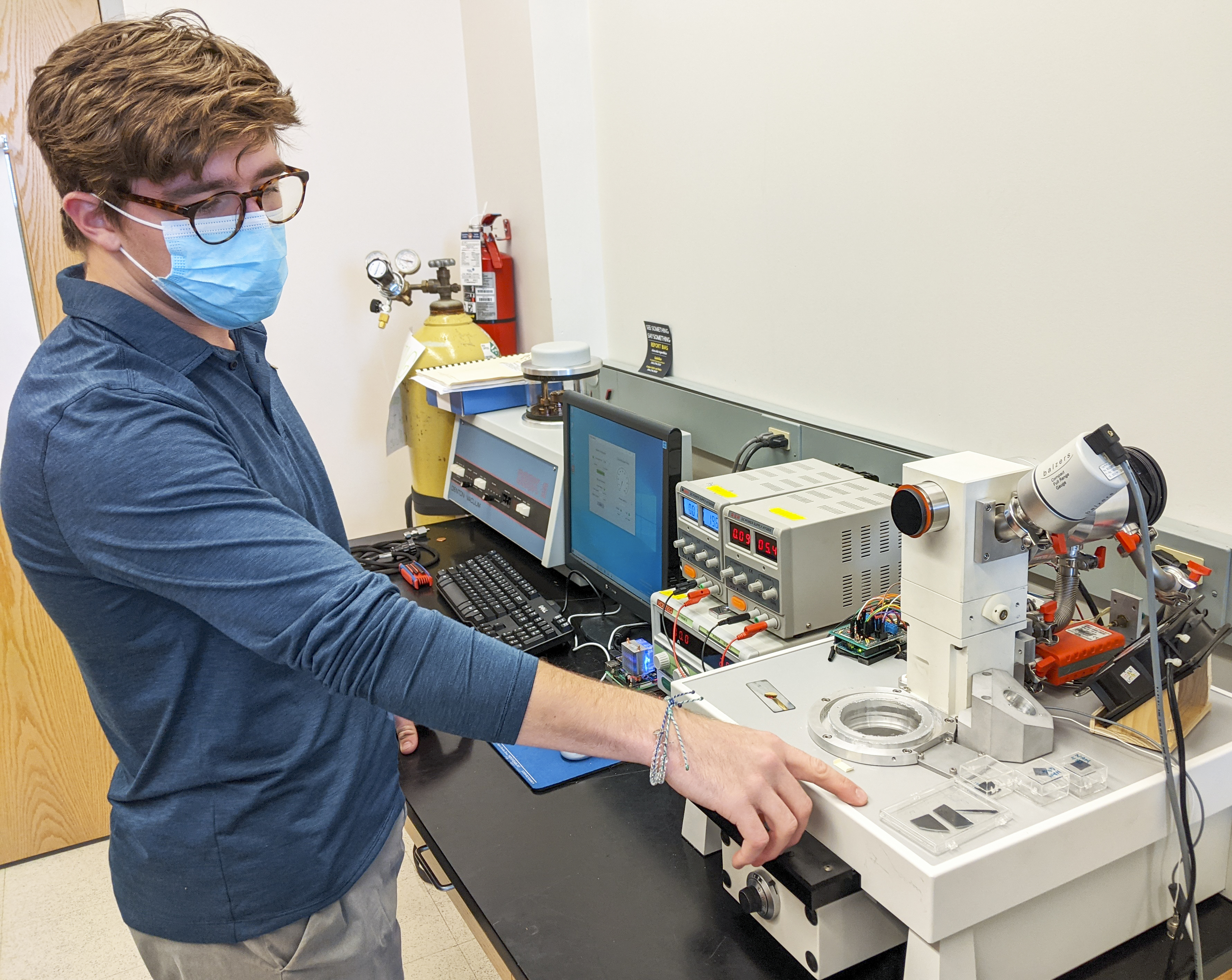
Chance鈥檚 research involves developing materials and conditions that would lead to thermionic energy conversion. He is a dual-degree engineering physics major and will transfer to a partner school next fall to complete his degrees.
What began as a spark of curiosity put Henry Chance 鈥�21 on a quest to solve 鈥渁 puzzle that the universe made鈥� and its potential to transform energy production.
That puzzle involves complex physics and engineering around thermal energy, the behavior of electrons inside vacuums and materials science.

Since last summer, Chance 鈥� a dual-degree engineering and physics major 鈥� has been building and experimenting with a vacuum chamber able to superheat semiconductors up to 700 degrees Celsius and then capture electrons expelled by that heat. Those released electrons are called thermions, and that process is called thermionic emission. In April, he鈥檒l present 鈥淧rototype Vacuum Thermionic Energy Conversion Device鈥� at the National Conference on Undergraduate Research.
Until fairly recently, the science behind Chance鈥檚 concept was mostly theoretical 鈥� but advances in materials science have brought it closer to reality. Hearing him explain it, it鈥檚 difficult not to be excited by the possibilities. What if we could harness excess heat at power plants to generate more electricity? What if the heat from car engines could be converted to electricity?
鈥淭hermionic emission is something we鈥檝e known about since Thomas Edison鈥檚 lightbulb, but thermionic energy converters are a more recent topic,鈥� Chance said.

Chance got curious about the concept during Associate Professor of Engineering Scott Wolter鈥檚 Structure and Properties of Materials course last spring. He noted that when heating a semiconductor, electrons move closer to the vacuum-energy level. When those electrons are heated beyond the vacuum-level, thermionic emissions occur. If we captured those electrons, it would make possible the conversion of heat directly into electricity 鈥� without the need for water and steam-turned turbines.
When Wolter offered him a broken scanning electron microscope to repurpose into a vacuum chamber for experimentation, Chance leaped. He applied for and received the Watts Grant, an annual endowed grant for math and natural science majors that provided $1,000 for materials and research.
鈥淭his is a challenging project and speaks to Henry鈥檚 taking on significant research,鈥� Wolter said. 鈥淗e loves being in the lab. I may drop in at times and Henry is there working on the system or studying more about the physics behind his device. He is always eager to learn more. He is very good at balancing planning and doing. He adheres to the scientific method in that he will consider an important question then work hard to find the answer. This trait of leveraging his knowledge and ability to research the literature and do simulations and then get things accomplished in the lab will take him far.鈥�
With Wolter鈥檚 guidance, he鈥檚 studying how to release and capture those flying electrons with the greatest success and least amount of energy required. The key is finding materials that will reach the thermionic state with the least amount of heat and pressure. As he completes his research this spring, he鈥檒l be experimenting with different formations of carbon nanotube mesh and cesium-oxide coatings.
鈥淚鈥檓 really thankful I鈥檓 at 黑料不打烊, because that鈥檚 the reason I鈥檓 able to do this. 黑料不打烊 offers a unique opportunity for students by allowing them the experience to work on projects this advanced as undergraduate students.鈥�
Henry Chance ’21
The process has been painstaking. He repurposed parts of the old microscope and constructed a high-powered vacuum, installed a heating system with external controls, wrote computer coding to control and measure the system, all while researching the scientific principles behind his ideas.
鈥淚鈥檓 really thankful I鈥檓 at 黑料不打烊, because that鈥檚 the reason I鈥檓 able to do this,鈥� Chance said. 鈥淢ost students at R1 universities don鈥檛 start working with vacuums until they鈥檙e at the doctorate level. Most undergraduate research there is coding or assisting rather than running experiments. 黑料不打烊 offers a unique opportunity for students by allowing them the experience to work on projects this advanced as undergraduate students.鈥�

Chance is most excited about contributing to an accelerating area of materials science and engineering. With the right materials and conditions, thermionic emissions could make fossil-fueled power plants more efficient 鈥� contributing to the health of the planet and wellbeing of humanity. Because space is already a vacuum, he sees potential for the thermionic emissions to power spacecraft.
鈥淚t鈥檚 really solving a puzzle that the universe made and you鈥檙e trying to figure it out,鈥� he said. 鈥淭hinking about all the potential applications it could have for all humanity is invigorating. And I鈥檓 just glad I have this opportunity. I don鈥檛 want to lose it, so I鈥檓 going to make full use of it.鈥�
Chance鈥檚 approach to modifying graphene nanotubes with cesium-oxide coatings to enhance electron emission should be a fruitful area of research, especially as we consider new renewable energy technologies, Wolter said.

鈥淗enry will be a successful researcher,鈥� Wolter said. 鈥淚 expect he will pursue academia as a career and do significant funded research. I already have thought about the day I see Henry leading a research group and doing amazing work and how proud I will be of him. I already am.鈥�
As a dual-degree major, he plans to transfer to Georgia Tech to complete his engineering degree in materials science. This summer, he鈥檚 been offered an internship with the U.S. Navy to research drone swarm technology, how large numbers of deployed drones could communicate with each other without a centralized information source. (Think of the way a flock of starlings maneuver in unison mid-flight.) Chance plans to study how slime mold transmits information about the location of food sources in that research.