


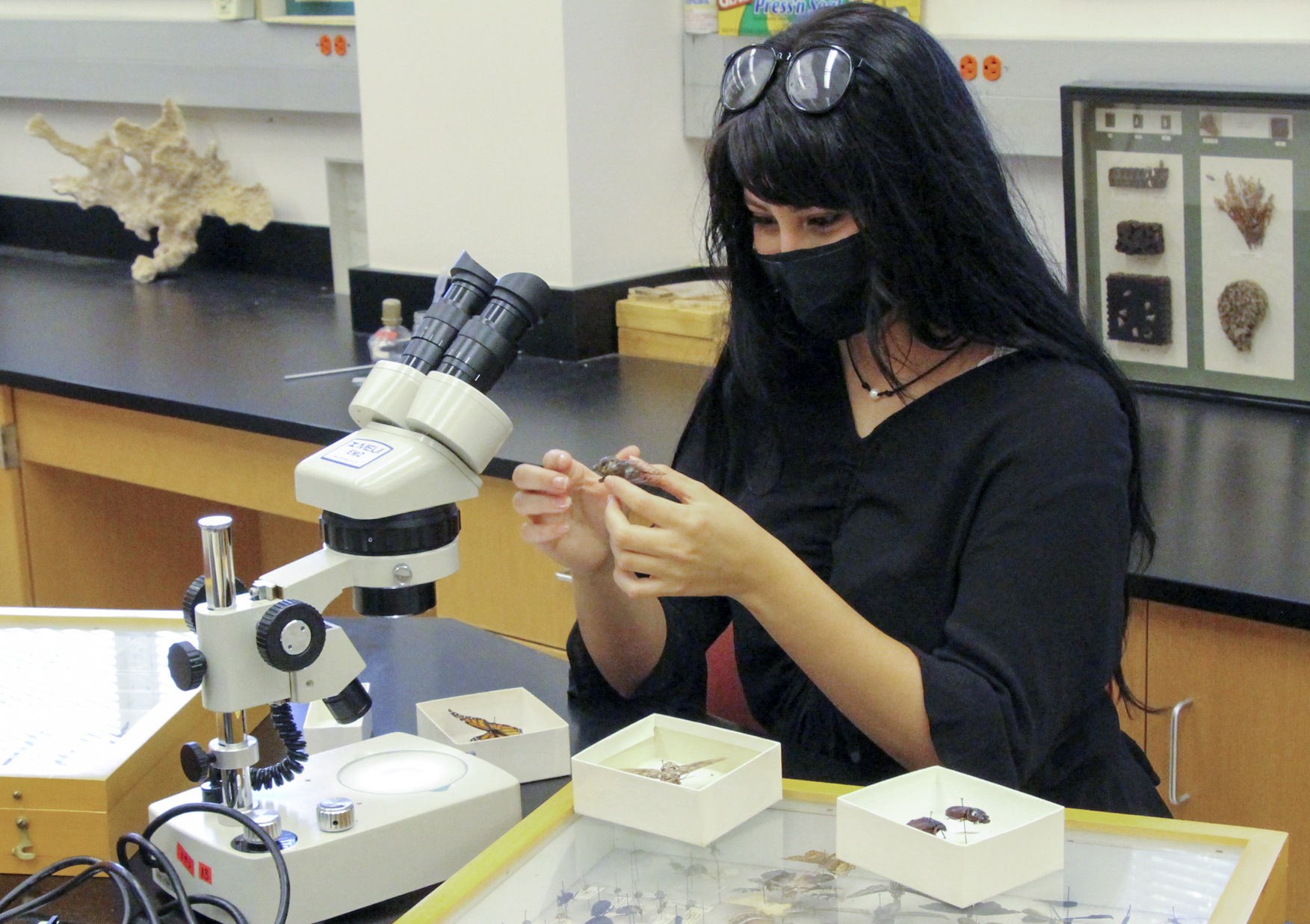
Now a budding scientist and entomologist with the Hamel Lab, Carranza is a first-generation, Latinx college student who once questioned her calling to science. Growing up, she rarely saw scientists who looked like her represented. Her summer internship raised the profile of an unheralded female entomologist from the 20th century and forged connections in her field.
Rebecca Carranza 鈥�22, realized early that she was more interested in bugs than most people.
As a young girl, she was endlessly fascinated by insects, hunting for and catching them, building an encyclopedic knowledge by reading every book and watching every nature special she could find. By high school she had her own specimen collection and found herself even more enthralled with their lifecycles, their relationships, the complex ways they communicate, and the role they play in ecosystems.

For Carranza, finding her passion wasn鈥檛 the difficult part. Finding the courage to follow it into higher education was.
A first-generation college student from a Latinx background, she questioned her place in the scientific field. When she read about scientists or saw them on screen, they were rarely women and almost never women of color. Could she belong in that field? Would she succeed, be accepted and her contributions valued? She recognizes now that better representation of women and minorities would have made her decision to pursue higher education less daunting.
This summer, Carranza set out to improve that.
Through a virtual internship at the Triplehorn Insect Collection at Ohio State University, , an unheralded female entomologist. Though Knull was an early curator of OSU鈥檚 collection, and though her published fieldwork and taxonomy yielded important discoveries, when she was mentioned in literature it was in relation to her scientist husband.
鈥淚t resonated with me,鈥� Carranza said. 鈥淗ere鈥檚 Dorothy Knull: She contributed so much, but she鈥檚 basically omitted from everything. She wrote more than 30 publications. She discovered new species of leafhoppers. She named them and characterized them, and she described many others.
鈥淭o do that work, to elevate her profile by gathering information about her work, knowing that someone else will read that and see that there are women in entomology who have contributed historically, it was very personal to me.鈥�
Carranza鈥檚 internship will be the foundation of future publications and a planned wiki pages about Knull. She鈥檒l continue that work from 黑料不打烊 this fall.

Not only does Carranza feel the internship contributed to her field, it also grew her connection within it.
She found a special bond working with Luciana Musetti of OSU鈥檚 Evolution, Ecology, and Organismal Biology Department and curator of the . They share similar backgrounds: Musetti is a native of Brazil, grew up in a home with few opportunities, but followed her interest in insects to become a biologist. Musetti also connected her to a network of Latinx scientists.
鈥淜nowing Dr. Musetti gives me that sense of, 鈥業 can do this too,鈥欌�� Carranza said.
Associate Professor of Biology Jen Hamel, who operates 黑料不打烊鈥檚 studying insect behavior, connected Carranza to Musetti. When Hamel put out calls on social media this spring asking for virtual internship opportunities for 黑料不打烊 undergraduates, a colleague connected her to OSU鈥檚 insect collection. She knew Carranza would be interested.
鈥淩ebecca is really hungry to learn things about how nature works. It鈥檚 genuine and ferocious,鈥� Hamel said. 鈥淪he is a fantastic research student: She has a ton of curiosity and genuine love of her research topic, which has to do with mutualism between two insect species and communication.鈥�
Carranza鈥檚 undergraduate research overseen by Hamel will focus on the symbiotic relationship between treehoppers, small cousins of cicadas, and species of ants that protect them to harvest the sap they leave behind, and also the vibrational communication treehoppers use.
Carranza began working in Hamel鈥檚 lab in 2019 after Professor of Biology and Environmental Studies Mike Kingston took notice of her interests and connected them.

Carranza is working as a teaching assistant for Kingston this fall. He saw Carranza鈥檚 enthusiasm during her first year and realized the interest in insects was a perfect fit for Hamel鈥檚 research, so he connected the two.
鈥淩ebecca is one of most passionate students I have met,鈥� Kingston said. 鈥淪he gets so excited about every new thing she learns about the natural world. She was born to be a natural scientist. She is bright, engaged, and a passionate student of nature, and a great teaching assistant because she loves to share her excitement for learning and biology with her fellow students.鈥�
Carranza is still determining her future path but sees graduate school for biology or entomology in her future.
鈥淭he thrill of discovery is something that has really drawn me toward biological research,鈥� she said. 鈥淭hinking about playing a role in bettering humanity鈥檚 understanding of a concept, species, or question is truly honorable in my eyes. I can鈥檛 get enough when it comes to learning about life, how our bodies work and how the living organisms around us exist.鈥�